

The Forward Deployed Engineer (FDE) has become one of the most interesting career opportunities in technology, especially as companies race to apply artificial intelligence within their workflows.
But what exactly does a Forward Deployed Engineer do? Is it simply a software developer with a different title, a technical consultant, or something entirely new?
The answer is a combination of all three, with one key difference: Forward Deployed Engineers turn technology into working solutions that solve real business problems.
Site owners may receive a commission on purchases via the links included on the page, at no extra cost to you.
If you enjoy programming, solving problems, and working directly with customers, this career lets you combine technical competence with measurable business impact.
What Is a Forward Deployed Engineer?
Want to cut to the chase and start your Forward Deployed Training now? Here’s your opportunity to be an early adopter.
A Forward Deployed Engineer is a technical professional who works closely with customers to design, build, integrate, and deploy software solutions within their business environments.
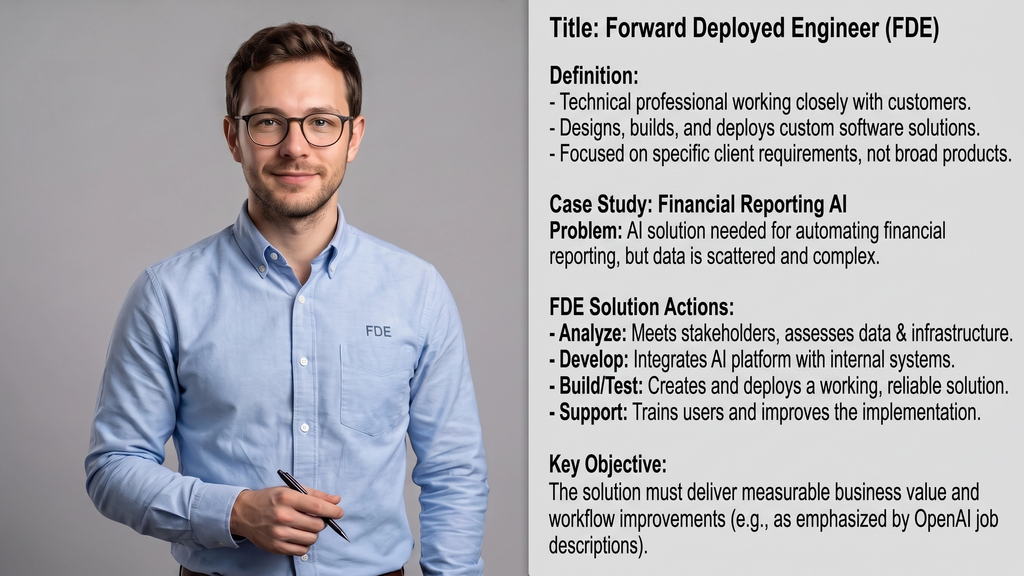
Unlike traditional software engineers, who often develop products for a broad customer base, FDEs focus on making technology work for specific customers and their requirements.
Suppose a company wants to automate its financial reporting and purchases an AI solution. If the company’s data is scattered across several places, the automation process becomes more challenging.
An FDE might:
- Meet with stakeholders to understand reporting requirements and business objectives.
- Examine the organization’s existing data and technical infrastructure.
- Develop integrations that connect the AI platform to internal systems.
- Build and test a working solution, addressing problems uncovered during deployment.
- Train users, measure results, and improve the implementation.
The job is not finished merely because the application runs. The solution must deliver value to the customer.
OpenAI’s Forward Deployed Engineer job description specifically emphasizes end-to-end deployment, customer adoption, and measurable workflow improvements.
Why Did the Role Emerge?
Palantir Technologies popularized the FDE model. Its engineers worked directly with customers facing complex data-integration and procedural challenges.
Palantir distinguished between engineers who built reusable platform capabilities and forward-deployed engineers who applied those capabilities to individual customers’ problems.
Palantir Blog
The underlying approach is not entirely new. Technical consultants and implementation engineers have worked closely with customers for decades.
What makes the modern FDE distinctive is the combination of substantial software engineering responsibility, direct customer engagement, and ownership of results.
Artificial intelligence has renewed interest in the model. An impressive AI demonstration may take days to develop, while making that same technology secure, reliable, and useful inside an established business can take considerably more effort.
That gap between demonstration and production is precisely where FDEs operate.
What Skills Does an FDE Need?
The role requires more than mastering a programming language. Employers seek people who can move comfortably between engineering, business requirements, and implementation.
| Category | Skills Needed |
| Software engineering | Python, JavaScript or TypeScript, APIs, debugging, testing, Git |
| Data engineering | SQL, ETL/ELT, data transformation, databases, integration |
| Cloud and deployment | AWS, Azure, or Google Cloud; Docker, CI/CD, logging |
| AI integration | LLM APIs, retrieval-augmented generation (RAG), evaluations, security |
| Business analysis | Requirements gathering, workflow mapping, ROI, defining success metrics |
| Communication | Explaining trade-offs, working with stakeholders, documenting decisions |
These are skill categories, not a requirement to master every technology.
Ready to start learning these skills yourself?
For example, OpenAI’s financial-services FDE positions emphasize software development alongside data flows, system reliability, auditability, and understanding financial workflows.
Another important distinction: not every FDE builds AI applications. Data platforms, enterprise software, workflow automation, and custom integrations still fall under the field.
How to Learn Forward Deployed Engineering
No single certification qualifies someone as an FDE. The most practical learning strategy is to build a software engineering foundation, then practice providing complete solutions.
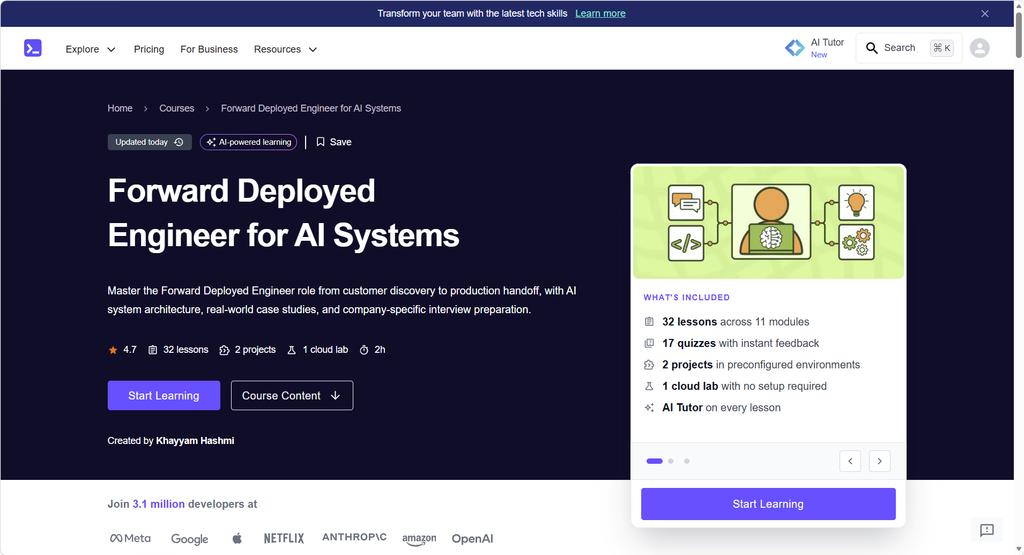
The good news is that Educative has a course that covers much of what you need to get off to a strong start.
https://datasciencereview.com/FDE
Practice Like a Forward Deployed Engineer
The best preparation is to simulate a customer engagement rather than complete another coding tutorial.
Imagine a regional logistics company that struggles to review its delivery costs. Its information resides in CSV files, spreadsheets, and a database.
Your assignment is to build a practical reporting and analysis system.
Sample FDE portfolio project: Logistics Cost Intelligence
Customer data
CSV files · Spreadsheets · SQL
Integration and validation
Python · APIs · Data quality checks
Working application
Dashboard · Cost analysis · Alerts
Business outcome
Faster reporting · Visible cost drivers
Build the project as though a real customer commissioned it:
- Write a short requirements document specifying the problem, assumptions, and success criteria.
- Build an application that imports, validates, and analyzes the company’s data.
- Include a dashboard or interface users can interact with.
- Deploy the application, test it, and document how it handles failures.
- Record the results using measurable criteria, such as report-generation time or data-validation accuracy.
Use synthetic data where necessary. Add AI only if it provides a meaningful benefit, such as answering questions about delivery-cost trends using verified company data.
Publish the project on GitHub with screenshots, architecture documentation, and a short demonstration video.
The objective is to show you can own a business problem from initial requirements through a working deployment. That is a stronger portfolio signal than an isolated application with no explanation of its intended users or business value.
How to Find a Forward Deployed Engineer Job
The most effective job search combines focused applications, networking, and evidence that you can deliver technical solutions.
1. Start with companies that employ FDEs
The following employer career pages provide useful starting points. Openings change, so check each company’s current listings.
Palantir
A natural starting point for understanding the role and finding forward-deployed software engineering positions.
OpenAI
FDE positions focused on applying advanced AI into enterprise workflows, including expert roles in financial services and healthcare.
Databricks
Explore forward-deployed and field-engineering opportunities involving enterprise data and AI platforms.
2. Search beyond the exact job title
Companies use different titles for overlapping responsibilities. Searching only for “Forward Deployed Engineer” may cause you to miss suitable positions.
Broaden your searches to include:
- Forward Deployed Software Engineer
- Solutions Engineer
- Field Engineer
- AI Implementation Engineer
- Customer Engineer
- Technical Solutions Consultant
These roles are not interchangeable. Some emphasize sales or support more than hands-on engineering. Read the responsibilities carefully.
Use LinkedIn Jobs, Indeed, and Y Combinator Jobs to search for these titles. Company career pages are especially useful for confirming openings and application requirements.
3. Demonstrate domain expertise
A candidate who understands both software engineering and a specific industry can add significant value to customer deployments.
For example, someone experienced in financial analysis who can also build Python applications and integrate data sources may have an advantage when applying to organizations that serve financial institutions.
The same applies to logistics, healthcare, manufacturing, and other industries in which understanding customer workflows is essential.
4. Prepare for a different kind of interview
Expect technical evaluation, but prepare to discuss business problems as well.
An interviewer may ask how you would integrate an AI application with an existing database, handle unreliable data, prioritize conflicting customer requirements, or measure whether a deployment succeeded.
Prepare a portfolio walkthrough that demonstrates not just what you built, but why you built it, which trade-offs you made, and how you evaluated the outcome.
A useful exercise is to practice explaining one project twice: once to an engineering team and once to a nontechnical business executive.
Is Forward Deployed Engineering the Right Career for You?
Forward Deployed Engineering can be a rewarding career for people who want greater responsibility for how technology is used, rather than concentrating exclusively on writing software.
It also comes with trade-offs. Some roles require frequent travel, extensive customer interaction, and comfort with ambiguity. For example, OpenAI lists travel requirements of up to 50% for certain FDE positions.
The strongest candidates combine technical depth with the ability to understand business needs, make practical engineering decisions, and communicate clearly.
For aspiring FDEs, the path is clear, even if the work is challenging: learn the fundamentals, build complete solutions, practice customer-facing problem-solving, and develop a portfolio that demonstrates real engineering judgment.
The essential question is not simply whether you can write code.
It’s whether you can take a business problem, build a reliable solution, and prove it works.
That is the skill worth developing.





Be First to Comment