
You’ve been reading about generative AI for months. You follow the news; you’ve used ChatGPT and Midjourney, and you can drop “transformer” and “fine-tuning” into a conversation without blinking. Then you sit down for an interview, and the interviewer asks one calm question: “Can you walk me through how a generative model actually produces text?”
Site owner may receive commissions from purchases made from the links on this page, at no extra cost to you!
You freeze. Then, you try to regain your composure and all that comes out of your mouth is, “Well, it processes data, and the exact mechanism, I mean, it’s pretty complex.”
You may cringe from reading this, but that’s actually a good thing. It’s good because it’s fixable. But you have to recognize it as an issue that needs addressing.
The link from the video is here:
https://datasciencereview.com/know-gen-ai
The Illusion of Knowing
When you read about an unfamiliar topic, you immediately pick up surface-level information. But that’s not learning, and it deceives us into believing that it is. That’s why we feel disappointed when an interviewer blindsides us with a question. We had a false sense of learning that led us astray.
Interviewers tend to stump candidates in two ways. The first is a concept you’ve never encountered before. You’re confident about large language models, and then someone asks about diffusion models, or how a model gets adapted after pretraining, or how to keep an LLM from answering with stale information. You obsess about failing to answer the question because it was never on your radar.
The second is trickier, because you know the term but can’t explain it well enough. You’ve heard of Transformers, and you know they power tools like ChatGPT. But when the interviewer says, “Okay, elaborate on that,” you hear yourself say, “It’s based on Transformers, but I’m not sure of the exact details.”
In both cases, the interviewer isn’t being unfair. They’re checking whether you can explain a concept, not just name it. Naming something takes a few seconds of exposure. Explaining it means you’ve worked through the idea and can rebuild it from scratch on the spot.
A Quick Self-Test
Try this right now, with no notes, no search engine, and no AI assistant. Pick any of these and explain it out loud as if you were talking to a teammate:
- What is generative AI, and how does it differ from traditional machine learning?
- Why did Transformers replace older sequence models like RNNs?
- What does “attention” actually do?
- What’s the difference between pretraining and fine-tuning?
- How does an image model like a diffusion model create a picture from a text prompt?
- Why do LLMs hallucinate, and what can you do about it?
If you got through all six smoothly, you’re in better shape than most. If you found yourself saying “it’s kind of like…” and then trailing off, you’ve found your gaps, and that’s useful. Finding them now costs you nothing. Finding them mid-interview costs you the offer.
Don’t Beat Yourself Up
Plenty of capable people have walked out of an interview realizing they knew less than they thought. It feels humiliating in the moment, especially when the questions came faster than you could answer them. But it isn’t a verdict on your ability. It signals that your knowledge is surface-level, and surface-level knowledge is fixable, as mentioned before.
The question is how you fix it. Re-reading blog posts won’t do it, because that’s the same recognition-based learning that got you into this spot. Watching a few videos helps, but passive learning has the same problem. What works is a combination of three things.
What Actually Closes the Gap
First, you need solid instruction. Generative AI is built in layers. You can’t truly understand a Transformer without understanding the sequence models it replaced, and you can’t understand those without knowing how text gets turned into numbers in the first place. Skipping to the trendy part leaves you with a roof and no walls. You need the concepts in an order that builds on itself.
Second, you need hands-on practice. Explaining something fluently comes from touching it, not reading about it. When you’ve worked with the pieces yourself, you stop reciting definitions and start giving answers with the confidence of someone who’s seen how they behave.
Third, you need a way to start learning without friction. Anyone who’s tried to set up a development environment knows how a Saturday morning can disappear into dependency errors. If getting started takes two hours of configuration, you’ll find reasons to put it off. You want to open a lesson and start working.
Where Educative Fits In
This is why I’d point you toward Educative’s Generative AI Essentials course. It’s built around those three needs, and the lessons run right in your browser, so you don’t have to configure an environment. You open a lesson and start.
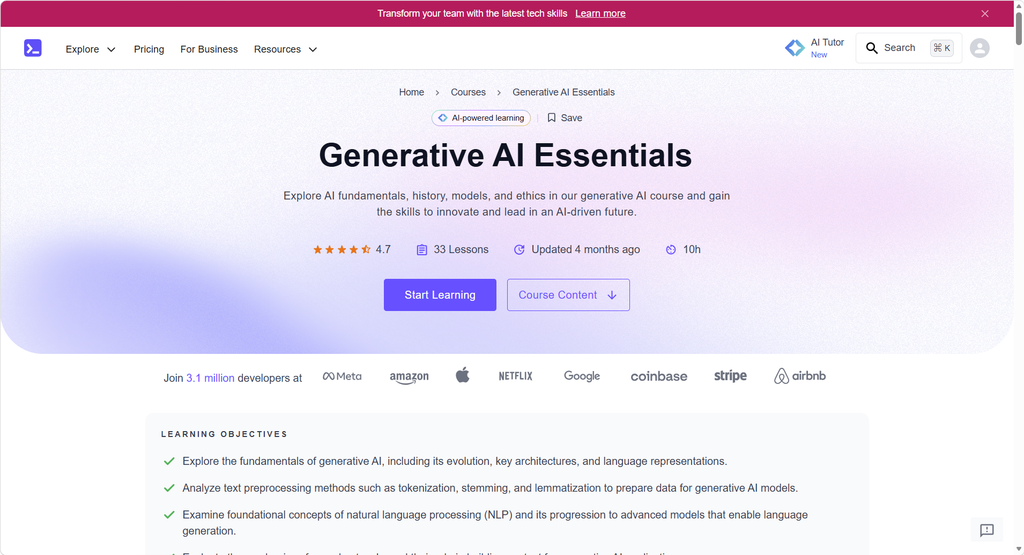
The more important part is the order in which it teaches things. It doesn’t open with a flashy demo. It builds the foundation first.
It starts with the basics: what generative AI is and why it’s worth learning. Then it moves into the building blocks, which is where many self-taught candidates have blind spots. You’ll cover text preprocessing, how language gets vectorized, and how neurons build context. From there, you see how sequence models reconstruct context and how the encoder-decoder architecture learns phrase representations. That sets up the real turning point, “Attention Is All You Need.” By the time you reach Transformers, you aren’t memorizing a diagram. You understand the problems they were invented to solve.
Compare that to how most of us learned: a Transformer explainer here, a tweet there. That patchwork is exactly why the answers fall apart when you ask follow-up questions. A course that follows the field’s path gives you a mental model you can reason from. It also covers the landmark ideas behind BERT and GPT, including bidirectional understanding and generative pretraining. Those come up in interviews more often than you’d expect.
Then you get to foundation models, which is the part of the course I’d flag for anyone interviewing right now. This section covers what foundation models are, how they learn, pretraining paradigms, and the whole spectrum of post-training, fine-tuning, and adaptation. It also covers model optimization for deployment and LLM evaluation. If you’re interviewing for anything beyond a purely academic role, interviewers use questions about adaptation, deployment trade-offs, and evaluation to separate people who’ve used AI from people who understand it.
It doesn’t stop at text, either. The course walks through how vision models learn to see, how diffusion models generate images, and how audio, music, and multimodal systems work. Plenty of candidates can talk about ChatGPT and then go quiet when the topic turns to how an image gets generated. A clear explanation makes you stand out.
The Practical Stuff Interviewers Love
Many modern interviews focus on how you’d use this technology, not just how it works. The course has a full section on this, covering prompt engineering, bridging static knowledge and dynamic context, and autonomous AI agents. That middle topic is the “how do you stop an LLM from relying on outdated knowledge” question in disguise, and agents are one of the hottest areas in the field right now. Explaining them clearly is a real advantage.
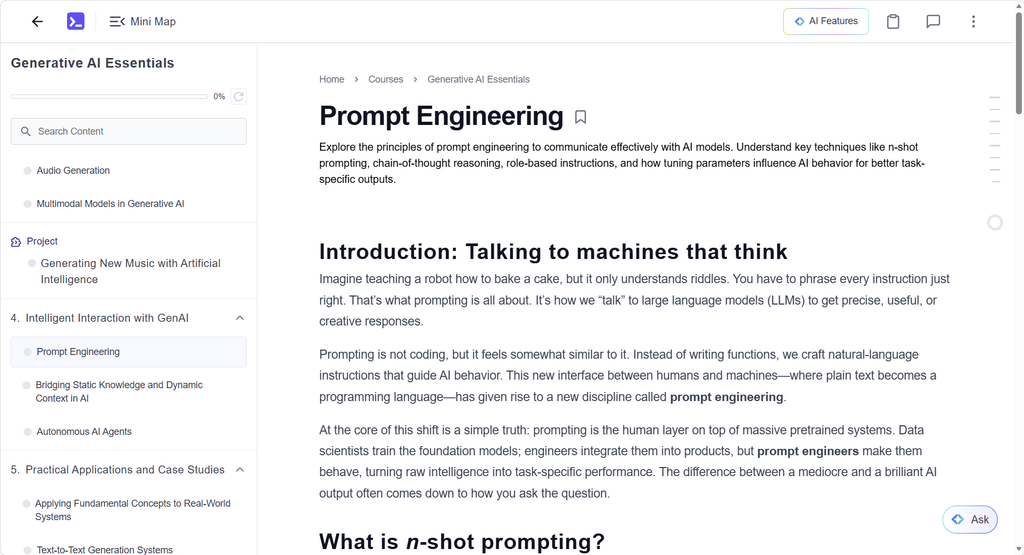
Then there are the case studies: text-to-text, text-to-image, text-to-speech, and text-to-video systems. They show you how the fundamentals combine in real products, which makes them great material for answering design-style questions. When an interviewer says, “How would you build a system that generates X?”, you want to have already practiced thinking that way.
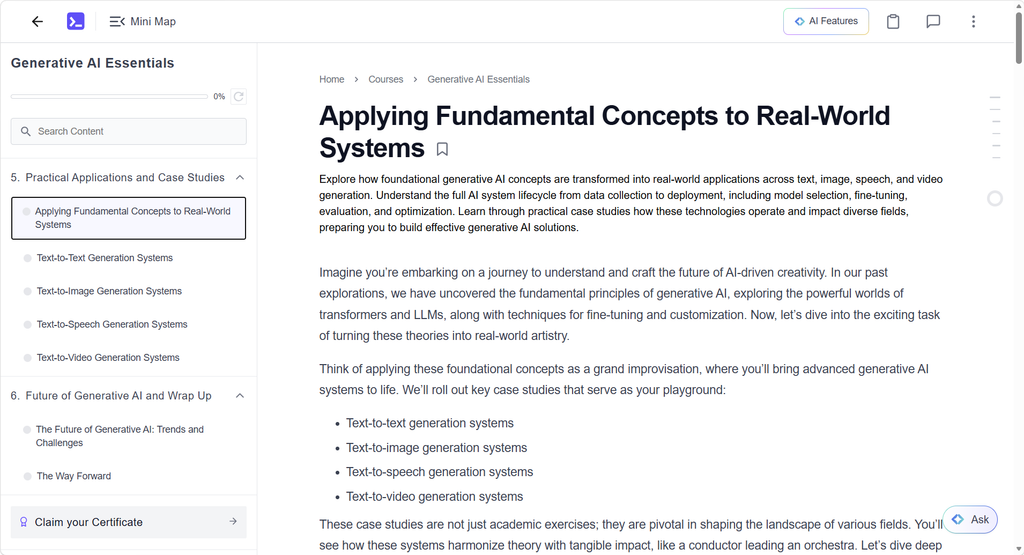
The course closes with trends, challenges, and ethical considerations. Don’t skip that part. “Where do you see this going, and what concerns you?” is a favorite closing question, and a thoughtful answer leaves a lasting impression.
Let’s Be Realistic
No course can predict the exact questions you’ll be asked, and anyone who promises otherwise is selling you something. Good training prepares you for the core questions that come up again and again and move you closer to an offer. The Educative instructors know what companies look for and keep the material current with the industry, which matters in a field that changes this fast.
Educative gives you the tools. What you do with them is up to you. If you’re already at the interview stage, or heading there soon, you’re exactly the person this course is for.
One Small Nudge
If you’ve been telling yourself you know this stuff well enough, take that self-test above again, this time out loud. If you hesitated, you have your answer.
For a limited time, you can get 55% off an Educative subscription. With one click, you get the preparation you need to stand out in a crowded job market, and you can start the first lesson today.
Finding your gaps before the interview, instead of during it, puts you ahead of most candidates. Now go close them. You’ve got this.






Be First to Comment